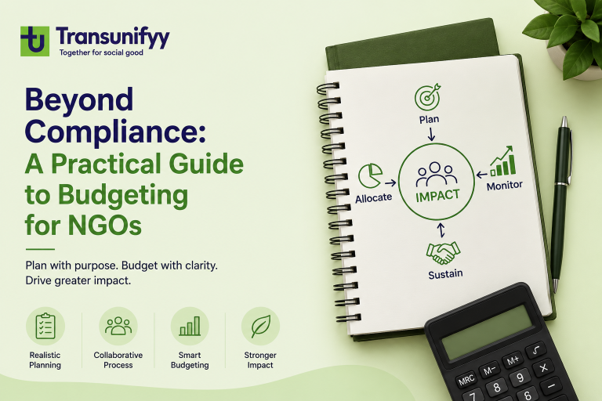
For many NGOs, the annual budget preparation exercise begins quietly in December and suddenly becomes urgent by January–February, when budgets need to be finalised, presented to the Board and submitted to statutory authorities such as the Charity Commissioner. In practice, budgeting in social development organisations is often treated as a financial or compliance-driven activity. However, when done thoughtfully, budgeting can become one of the most powerful planning and decision-making tools for an organisation.
The basic idea behind writing this article is to help NGOs to develop an understanding about how they can approach budget preparation more strategically, who should be involved, what projects should be considered, how budgets should be consolidated and how learning from previous years can improve realism and sustainability.
1. Budgeting is Organisational Planning, Not Just Accounting
A common misconception is that budgets are the responsibility of the finance or accounts team alone. While financial teams play a critical role, an NGO's budget is fundamentally a reflection of its mission, priorities and implementation capacity.
A meaningful budget answers questions such as:
- What social change do we want to prioritise in the coming year?
- Which communities, themes, or geographies will we focus on?
- Do we have the staff, systems and partnerships required to deliver?
If budgeting is disconnected from program planning, organisations often face challenges later like unfunded activities, overstretched teams or unrealistic expectations from donors and Boards. Hence, budgeting must be seen as a cross-functional process involving program, finance, leadership and governance teams.
2. Budget Preparation: From Ground Realities to Financial Planning
In most charitable trusts and other social development organisations, the budget preparation process typically begins in January, rather than earlier in the year. This timing is not accidental. It reflects the point at which programmatic clarity, funding visibility, and ground-level learning begin to converge. By January, Program Managers and Thematic Leads are usually clear on several critical aspects that are essential for realistic budgeting.
First, there is clarity on the status of ongoing projects:
- Which projects are concluding by March
- Which multi-year projects will continue into the next financial year
- What expenditures are already committed through signed agreements
Second, there is better visibility on sanctioned and near-sanctioned projects for the coming year:
- Projects already approved by donors or CSR partners
- Projects where sanction letters are expected shortly
- Renewals or scale-up of existing partnerships
Third and most importantly, program teams have a deep understanding of ground realities and program learnings:
- Which interventions have worked well in specific geographies
- Where there is demand for replication or expansion
- Which models may need redesign or additional support based on field experience
At the same time, CSR donor agencies also begin finalising their plans for the next financial year during this period. This includes identifying priority thematic areas and geographies, onboarding new NGO partners and initiating processes such as impact assessments, baseline studies and due diligence for fresh projects.
Translating Program Inputs into Budgets
- Ask each program head/thematic head to prepare activity-wise budgets for their projects.
- Use simple templates that break costs into:
- Programmatic cost
- Personnel cost
- Travel and logistics
- Monitoring, Documentation and reporting
- Administrative and Overhead cost
- Conduct internal discussions where teams explain why certain costs are needed.
This bottom-up approach not only improves accuracy but also builds ownership and accountability, as teams understand the financial implications of their plans.
3. From Thematic Planning to Organisational Budgeting
Recognising this reality, senior management teams in trusts and other NGOs usually formally call for budgets from each thematic or program lead during January. A good practice is to structure these budget submissions clearly under categories such as:
- Already Sanctioned Projects (confirmed funding, committed spend)
- Ongoing Multi-Year Projects (carry-forward costs only)
- Pipeline Projects (under discussion or proposal stage)
- New / Strategic Proposals (aligned with organisational vision but not yet funded)
This exercise can be conducted:
- At the thematic level (education, health, livelihoods, environment, etc.), or
- At the program level, especially in organisations with large flagship projects
Once these inputs are received, the role of senior management or the resource mobilisation team becomes critical. At this stage, budgets are:
- Reviewed against previous years' experience
- Adjusted based on fund mobilisation trends
- Aligned with the organisation's strategic vision, staffing capacity and systems
4. Consolidation, Trustee Approval and Statutory Submission
After internal consolidation, the draft organisational budget is typically:
- Reviewed by the CEO / Secretary / Senior Leadership
- Presented to the Trustees or Board for discussion and approval
Trustee review is not merely procedural. It often focuses on:
- Whether growth ambitions are financially sustainable
- Risk exposure due to uncertain funding
- Alignment with the trust's long-term mission and values
Once approved, the budget must be translated into the prescribed format of the Charity Commissioner and submitted on or before 28th/29th February.
Understanding the Charity Commissioner Budget Format
The Charity Commissioner's budget format typically requires NGOs to present:
- Estimated Receipts for the coming financial year (donations, grants, interest, other sources)
- Proposed expenditure, broadly classified under:
- Program or charitable activities
- Establishment and staff-related expenses
- Administrative and office expenses
- Project-wise or activity-wise outlays, where applicable
- Clear alignment with the organisation's objects and purposes as stated in the Trust Deed or Memorandum
This statutory format is designed for transparency and regulatory oversight, not for internal planning. Therefore, budgets prepared only at this stage without a strong internal process often fail to reflect actual implementation realities.
5. Why Robust Internal Preparation Matters
This step is often underestimated. Simply "filling figures" into the statutory format without evidence from program plans, funding visibility or past experience can result in:
- Unrealistic expenditure projections
- Large gaps between budgeted outlay and actual project implementation
- Credibility issues during audits, inspections or reviews
In smaller organisations especially, where budgets are sometimes prepared purely as a compliance formality, the difference between budgeted figures and actual funds mobilised can be significant.
Following a structured, evidence-based budget preparation process is not just about compliance. It ensures that:
- The organisation enters the new financial year with clarity and confidence
- Action plans are grounded in realistic financial assumptions
- Delays, penalties or explanations to the Charity Commissioner are avoided
- Leadership teams are prepared for informed engagement with donors and partners
Timely and thoughtful budget submission also sets the tone for the year ahead, allowing NGOs to focus on implementation and impact, rather than firefighting compliance gaps.
Looking to strengthen your programme monitoring or impact measurement systems? Transunifyy works with NGOs, CSR teams and foundations across India to design evaluation frameworks, conduct impact assessments, build digital monitoring systems and generate evidence for stronger social impact.
Connect with us to explore how we can support your organisation.