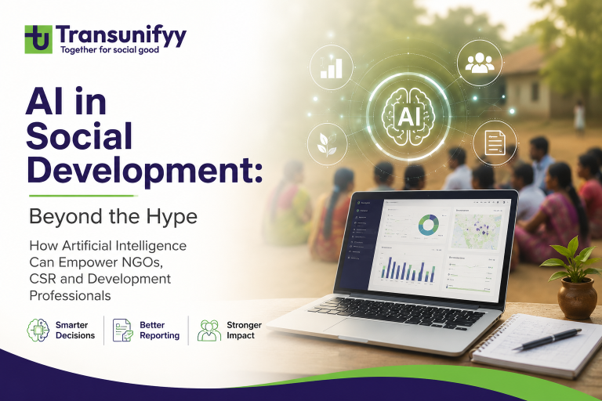
AI in social development is no longer experimental
For decades, social development in India has been driven by intent, relationships, and ground-level effort. Programme managers designed interventions based on experience. Field teams collected data on paper. Reports were compiled manually over weeks. And impact was measured — if at all — through retrospective evaluations conducted months after a programme ended.
That model is changing. Artificial intelligence is entering the social sector not as a futuristic concept but as a practical tool that is already reshaping how programmes are designed, delivered, monitored, and measured.
The shift is quiet but significant. AI is not replacing social workers or programme managers. It is augmenting their capabilities — helping them make better decisions faster, identify patterns they would miss, and communicate impact more effectively.
This article explores how AI is being applied across the social development and CSR landscape in India, what is working, what is emerging, and what organisations should be thinking about.
AI-powered programme design
Traditionally, CSR and development programmes are designed based on needs assessments, baseline studies, and the experience of programme teams. This process takes weeks or months and is limited by the data that can be practically collected and analysed.
AI is changing this by enabling analysis of large datasets from census data, government surveys, satellite imagery, and existing programme records to identify where interventions are most needed, which populations are most underserved, and what intervention models have worked in similar contexts.
For example, AI can analyse district-level health, education, and livelihood data to help a corporate foundation decide where to focus its CSR investment for maximum impact. Instead of selecting districts based on proximity to plant locations or existing NGO relationships, the decision becomes evidence-driven.
At Transunifyy, our SocioAI engine helps organisations structure project designs with AI-generated activity plans, KPI frameworks, and budget estimates — reducing programme design time from weeks to hours while improving the rigour of the design process.
Predictive analytics for early intervention
One of the most powerful applications of AI in social development is predictive analytics — using historical data to forecast future outcomes and identify risks before they materialise.
In education programmes, AI can predict which students are at risk of dropping out based on attendance patterns, assessment scores, and demographic factors. Programme managers can intervene with targeted support before the dropout happens rather than documenting it after the fact.
In livelihood programmes, AI can identify which beneficiaries are most likely to sustain their micro-enterprises based on training completion, market access, follow-up engagement, and local economic conditions. Resources can be directed toward those who need additional support rather than distributed uniformly.
In health programmes, AI can flag communities where vaccination coverage or nutrition indicators are declining before they reach critical thresholds, enabling proactive rather than reactive responses.
The prerequisite for predictive analytics is good data. Organisations using digital platforms like Transunifyy for continuous data collection are building the datasets that make prediction possible. Those still relying on annual surveys and manual records are not.
AI-powered field data collection
The quality of any social programme depends on the quality of data collected from the field. Traditionally, this has been one of the weakest links — paper forms filled inconsistently, data entry errors during manual digitisation, weeks of delay between collection and analysis.
AI is improving field data collection in several ways. Intelligent form validation catches errors and inconsistencies at the point of data entry rather than during later quality checks. Anomaly detection flags unusual responses that may indicate data quality issues or genuine outliers requiring investigation.
Voice-to-text in regional languages — a feature built into Transunifyy's mobile app — allows field workers to dictate observations and progress updates in Hindi, Marathi, Tamil, Telugu, Kannada, and other languages. The AI transcribes, structures, and feeds the input directly into project records. This removes the language and literacy barrier that has historically limited digital adoption among field teams.
Geo-tagged and timestamped data collection with AI-powered duplicate detection ensures that beneficiary records are accurate, unique, and verifiable.
Automated reporting and donor communication
Report writing is one of the largest time sinks in the social sector. NGOs managing multiple donor-funded programmes spend 30 to 40 percent of their administrative time compiling quarterly reports, each in a different format for a different donor.
AI is automating this entirely. Transunifyy's SocioAI generates complete donor reports — including narrative text, data tables, charts, beneficiary maps, outcome summaries, and financial utilisation — from live project data. A report that previously took 14 days to compile can be generated in minutes.
Beyond speed, AI improves report quality. It ensures consistency between narrative claims and underlying data. It formats reports to meet specific donor requirements. And it generates impact narratives that go beyond listing activities to explain what changed and why it matters.
For CSR teams, AI-generated annual reports pull directly from dashboard data, mapping expenditure to Schedule VII categories, calculating SROI ratios, and producing board-ready presentations without manual compilation.
Natural language querying of programme data
One of the most transformative AI capabilities for programme managers is the ability to ask questions about their data in plain language.
Instead of navigating complex dashboards, filtering data tables, and exporting spreadsheets, a programme manager can simply ask: "How many women completed the livelihood training in Rajasthan this quarter?" or "Which district has the highest beneficiary dropout rate?" or "Compare budget utilisation across our top 5 implementing partners."
The AI processes the question, queries the underlying database, and returns an answer with supporting data — in seconds.
This capability is especially powerful for senior leadership and board members who need quick answers during meetings without waiting for someone to prepare a data pull. Transunifyy's SocioAI supports natural language querying across all project and beneficiary data on the platform.
AI for proposal writing and fundraising
NGOs spend significant time writing funding proposals — often rewriting their organisational profile, methodology, and past experience from scratch for each RFP. AI is reducing this burden dramatically.
AI-powered proposal writers can analyse RFP requirements, pull relevant information from the organisation's existing project data, track record, and capabilities, and generate a structured first draft that the team refines. What previously took 3 to 5 days can be completed in hours.
This matters particularly for smaller NGOs that lack dedicated proposal writing staff. AI levels the playing field, giving smaller organisations the ability to respond to funding opportunities they would otherwise miss due to capacity constraints.
Transunifyy's SocioAI proposal writer is trained specifically for Indian social sector requirements — understanding the terminology, compliance frameworks, and reporting standards that Indian donors and CSR teams expect.
AI in impact measurement and SROI
Measuring social impact has traditionally been expensive and time-consuming — requiring external evaluators, months of data collection, and complex analysis. AI is making impact measurement faster, cheaper, and more continuous.
AI can track outcome indicators in real-time as data flows in from the field, rather than waiting for periodic evaluation exercises. It can calculate SROI automatically by applying financial proxies to measured social outcomes. It can identify causal patterns — which interventions produce the strongest outcomes for which beneficiary segments in which geographies.
This continuous, AI-powered impact measurement is fundamentally different from the traditional model of periodic external evaluation. It enables programme managers to see what is working and what is not while the programme is still running — in time to make adjustments.
Transunifyy's platform integrates impact measurement directly into project management. Baseline data is captured at programme commencement, outcome indicators are tracked throughout implementation, and SROI is calculated from the same data that flows through the project dashboard.
Ethical considerations and responsible AI
The application of AI in social development raises important ethical questions that organisations must address thoughtfully.
Data privacy and consent. AI systems require data to function. In the social sector, this data often comes from vulnerable populations — rural communities, women, children, persons with disabilities. Organisations must ensure informed consent, data minimisation, secure storage, and compliance with the Digital Personal Data Protection Act 2023.
Algorithmic bias. AI systems can perpetuate or amplify existing biases if trained on biased data. A predictive model that recommends targeting certain communities for intervention based on historical patterns may inadvertently reinforce existing inequities. Organisations must audit their AI systems for bias and ensure equitable outcomes.
Human oversight. AI should augment human decision-making, not replace it. Programme design, partner selection, and beneficiary targeting should involve human judgment informed by AI insights, not automated AI decisions without human review.
Transparency. Organisations using AI should be transparent with stakeholders — including beneficiaries, donors, and partners — about how AI is being used, what data feeds it, and how decisions are influenced by AI recommendations.
What organisations should do now
AI in social development is not a future possibility. It is a present reality. Organisations that begin building AI-ready infrastructure today will have a significant advantage in programme effectiveness, reporting efficiency, and impact credibility.
The starting point is not buying an AI tool. It is building the data foundation that AI requires. This means moving from paper-based and Excel-based data management to digital platforms that collect structured, continuous, geo-tagged data from the field.
Organisations already using platforms like Transunifyy are building this foundation as a byproduct of their daily operations. Every beneficiary record, every activity update, every survey response, every financial transaction becomes training data for AI-powered analytics, predictions, and reporting.
The organisations that will lead social development in the next decade are not necessarily those with the largest budgets. They are those that combine deep field expertise with intelligent technology — using AI to amplify human judgment, not replace it.
Transunifyy is India's AI-powered CSR management software and NGO MIS platform. SocioAI — our built-in AI engine — helps organisations generate proposals, reports, and project plans, query data in natural language, and measure impact continuously. Register free to explore how AI can transform your social programmes.