Why choosing the right CSR management software matters
Indian corporates spend over ₹25,000 crore on CSR annually. Yet most CSR teams still manage this spending through Excel spreadsheets, email attachments, and quarterly PDF reports from implementing NGOs. The typical corporate CSR team managing 5 to 15 NGO partners across multiple states spends more time aggregating data than designing better programmes.
CSR management software solves this — but only if you choose the right one. The wrong CSR software costs more than the subscription fee. It costs a year of poorly structured data, frustrated teams, delayed compliance filings, and a board presentation you are not confident about.
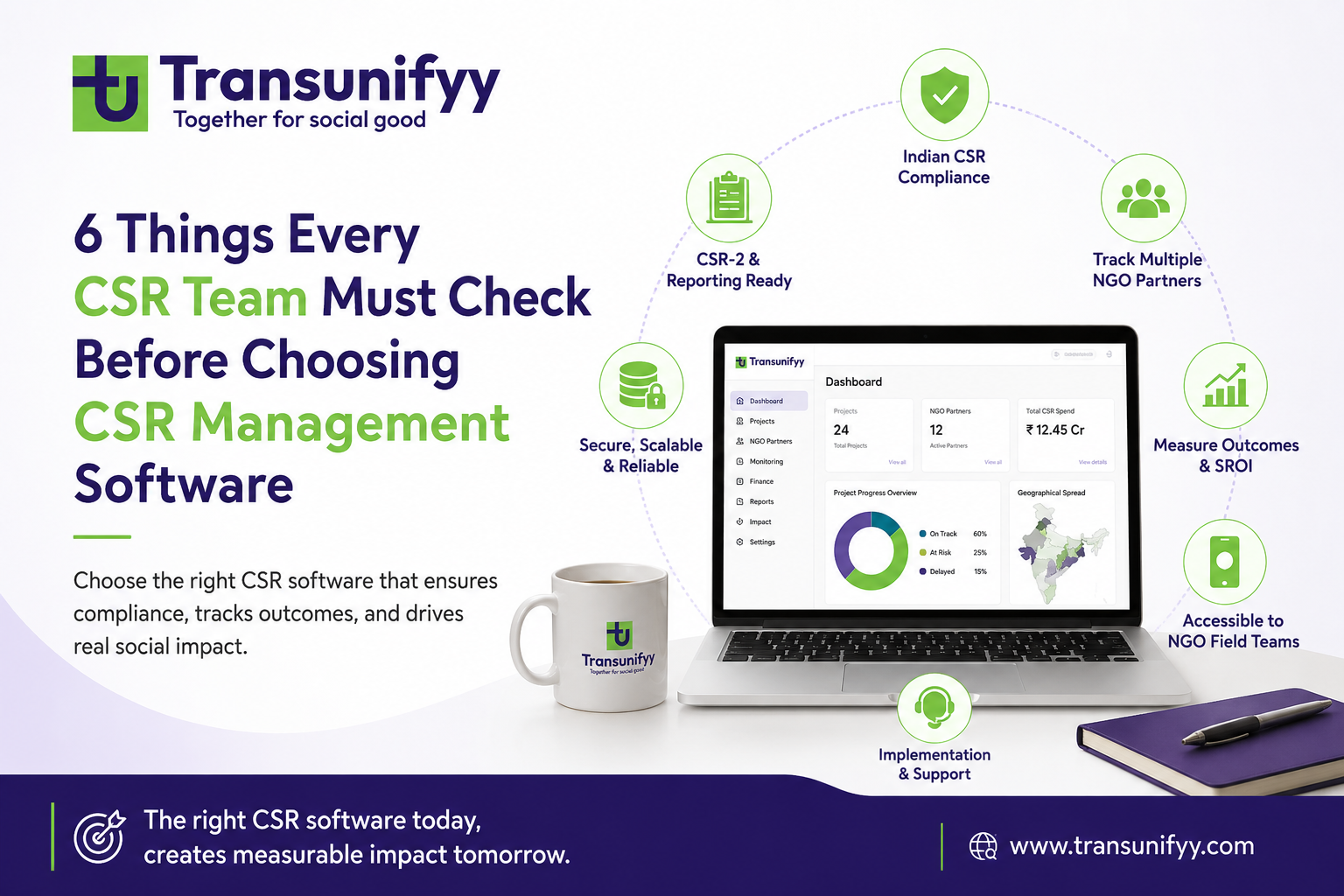
Before you evaluate any CSR management software or CSR MIS platform, here are 6 non-negotiable criteria that separate tools built for Indian CSR from generic project management software adapted for social impact.
1. Does it understand Indian CSR compliance — Section 135, Schedule VII, and CSR-2?
This is the first and most important filter. Indian CSR operates under a specific regulatory framework that generic global CSR platforms do not understand.
Your CSR management software must support Section 135 compliance tracking with automatic documentation of qualifying CSR expenditure. It should map every project to the correct Schedule VII activity category without manual classification. The CSR software should generate data formatted for CSR-2 filing so your company secretary is not scrambling in March. It must maintain audit trails that satisfy statutory auditors and the Ministry of Corporate Affairs.
If the CSR software was built for a global market and adapted for India as an afterthought, it will miss these India-specific compliance requirements. You will end up maintaining a parallel compliance system outside the software — which defeats the entire purpose.
Test question to ask the vendor: Can you show me a CSR-2 report generated directly from your platform using live project data?
2. Can it track multiple NGO implementing partners on one dashboard?
Most Indian CSR programmes work through implementing NGO partners. A typical corporate CSR team manages 5 to 15 NGOs, each operating in different states, different sectors, and different reporting formats.
Your CSR management software must provide a single dashboard showing all NGO partners, all projects, all geographies, and all financial data in one view. The CSR software should allow each NGO partner to report directly on the platform — uploading progress data, financial utilisation, and beneficiary information — so the corporate CSR team sees real-time updates instead of chasing quarterly Excel reports.
The CSR monitoring dashboard should support partner performance comparison — which NGO is on track, which is behind, which has utilisation gaps. Without this, the CSR team has no objective basis for partner evaluation or continuation decisions.
Test question to ask the vendor: If I have 10 NGO partners across 6 states, can I see all their project progress on one screen without any manual consolidation?
3. Does the CSR software measure outcomes and SROI — not just track expenditure?
CSR compliance requires tracking expenditure. CSR effectiveness requires tracking outcomes.
Most CSR management software stops at financial tracking — budget allocated, amount disbursed, amount utilised. This tells the board how much was spent but nothing about what changed. When the board asks "What was the Social Return on Investment of our livelihood programme?" — expenditure tracking cannot answer that question.
The CSR software you choose should capture baseline data at project commencement so you have a reference point for measuring change. It should track outcome indicators throughout implementation, not just outputs like number of people trained. It should calculate SROI automatically using financial proxies applied to measured social outcomes. And it should generate impact reports that go beyond activity lists to show actual changes in beneficiary lives.
If the CSR platform only tracks inputs and outputs, you will still need a separate impact assessment exercise every time the board or a stakeholder asks about effectiveness. That is an expensive gap.
Test question to ask the vendor: Can your platform show me the SROI of a specific project using data already in the system?
4. Is the platform accessible to NGO field teams — not just corporate users?
CSR management software fails when it is designed only for the corporate CSR team sitting in a Mumbai or Pune office. The actual data originates from NGO field workers operating in rural villages, often with limited internet connectivity and varying levels of digital literacy.
Your CSR software must include a mobile app that NGO field teams can use to report progress, collect beneficiary data, and upload photo evidence directly from the field. The mobile app must work offline — field workers in Nandurbar or Kokrajhar cannot wait for 4G connectivity to submit a survey. Data should sync automatically when the device reconnects.
Bonus: look for CSR management software that supports voice-to-text input in regional languages. If your implementing NGOs work in Hindi, Marathi, Tamil, or Telugu-speaking communities, field workers should be able to dictate progress updates in their local language rather than typing in English.
Test question to ask the vendor: Can a field worker in a village with no internet still collect and submit data through your platform?
5. Does it offer AI-powered reporting — or just data storage?
There is a fundamental difference between CSR software that stores data and CSR software that generates intelligence from that data.
Basic CSR management software gives you dashboards and download buttons. Advanced CSR management software uses AI to generate annual CSR reports from live data, create board-ready impact summaries with narrative text, charts, and beneficiary maps, answer natural language questions like "which district has the highest dropout rate in our education programme", identify patterns and anomalies in project data that manual analysis would miss, and flag potential compliance risks before they become problems.
AI-powered CSR reporting can reduce the annual CSR report preparation time from 3 to 5 weeks to under an hour. For CSR teams that spend every February and March in report-compilation mode, this is a transformational capability.
Test question to ask the vendor: Can your AI generate a complete quarterly CSR report from the data in the system — including narrative, charts, and recommendations?
6. Is it built by people who understand the social sector — or by a generic software company?
This is the criterion most CSR teams overlook — and the one that matters most in the long run.
Generic project management tools can be configured to track CSR projects. But they do not understand the nuances of how Indian CSR programmes actually operate: the relationship dynamics between corporates and NGOs, the compliance calendar pressures in January through March, the challenges of field data collection in low-connectivity areas, the difference between Schedule VII categories, or the specific reporting formats that different donors require.
CSR management software built by a team with deep social sector experience will have these workflows built in from the start — not as add-on features requested by customers after launch.
Ask the vendor: How many years has your team worked in the social sector? How many districts have they operated in? Have they personally managed CSR programmes, conducted impact assessments, or worked with implementing NGOs on the ground?
Test question to ask the vendor: Tell me about your team's experience implementing CSR programmes in the field — not just building software.
How Transunifyy scores on all 6 criteria
Transunifyy is an AI-powered CSR management software built by social sector professionals with over 20 years of field experience across 200+ districts in India. Here is how it performs on each criterion:
Indian CSR compliance: Section 135 tracking, Schedule VII mapping, CSR-2 reporting data, automated utilisation certificates, and audit trails — all built in from day one.
Multi-partner dashboard: All NGO implementing partners report on one platform. Corporate CSR teams see real-time dashboards with partner performance comparison, financial tracking, and project monitoring across all states and sectors.
Outcome measurement and SROI: Baseline data capture, continuous outcome tracking, automated SROI calculation, and board-ready impact reports that go beyond expenditure summaries.
Field team accessibility: Mobile app with offline data collection, voice-to-text in Hindi, Marathi, Tamil, Telugu, and Kannada, geo-tagged photo evidence, and automatic sync to the central MIS dashboard.
AI-powered reporting: SocioAI generates CSR annual reports, quarterly updates, impact narratives, and board presentations from live platform data. Natural language querying lets CSR teams ask questions and get instant answers.
Social sector expertise: Our team has personally implemented CSR programmes, conducted impact assessments, designed M&E frameworks, and worked with NGOs across 200+ districts before building the platform. Every feature exists because we faced the challenge ourselves.
Getting started
Registration on Transunifyy is free. No credit card required, no sales pitch, no 6-month implementation. Set up your CSR dashboard in 5 minutes and invite your implementing partners.
If you are currently evaluating CSR management software for your organisation, use the 6 criteria above as your evaluation framework — regardless of which platform you ultimately choose. The right CSR software will save your team hundreds of hours annually and transform your CSR reporting from a compliance exercise into a strategic capability.
Transunifyy is an AI-powered CSR management software that helps corporates, NGOs, and foundations track projects, measure impact, and automate reporting. Register free to get started.