Why choosing the right NGO management software matters
Every NGO reaches a point where Excel stops working. Maybe it is when the team grows from 5 to 20 people and nobody trusts anyone else's spreadsheet. Maybe it is when the donor asks for a quarterly report and it takes 14 days to compile. Or maybe it is when the M&E officer leaves and three years of beneficiary data walks out the door.
That is when NGOs start looking for NGO management software — an MIS platform that can centralise project data, automate reporting, and bring order to the operational chaos that scaling creates.
But here is the problem: most NGO management software was not built for Indian NGOs. It was built for international nonprofits with stable internet, English-speaking teams, and donors who accept Salesforce-formatted reports. Indian NGOs face a fundamentally different reality — rural field operations, regional language requirements, FCRA compliance, multiple donor formats, and teams with limited digital literacy.
Choosing the wrong NGO software costs you a year of data migration pain, frustrated field teams, and a system that collects dust while everyone goes back to WhatsApp and Excel.
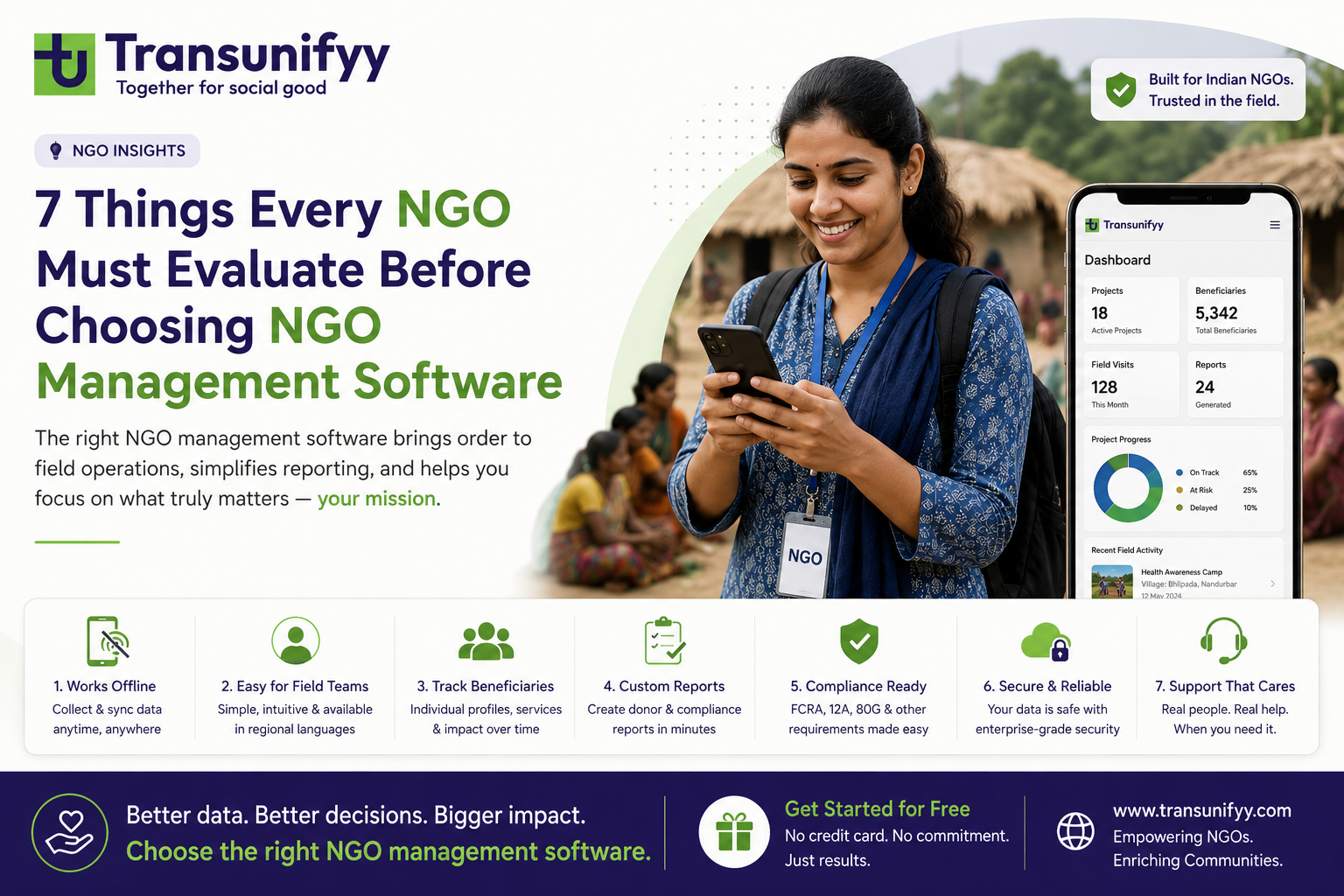
Here are 7 criteria every Indian NGO should evaluate before selecting NGO management software.
1. Does the NGO software work offline in the field?
This is the single most important criterion for any NGO operating outside metro cities. If your field teams work in rural areas — and most Indian NGO field teams do — they face inconsistent or zero internet connectivity for significant portions of their working day.
Your NGO management software must include a mobile app that works completely offline. Field workers should be able to collect beneficiary data, record project activity progress, complete surveys, capture geo-tagged photographs, and update milestones without any internet connection. The data must sync automatically to the central MIS dashboard when the device reconnects — whether through WiFi or mobile data.
NGO software that requires constant internet connectivity is useless for a field team conducting household surveys in villages across Palghar, Nandurbar, or Kokrajhar. If the vendor says "it works with basic 2G" — test it yourself in an actual low-connectivity area before committing.
Test question to ask the vendor: Can your mobile app collect and store 50 beneficiary records with photos while completely offline, and sync them later without data loss?
2. Can your field team actually use it — without IT support?
Most NGO field workers are programme people, not technology people. They are trained in community mobilisation, health education, livelihood support, or agricultural extension — not in navigating complex software interfaces.
Your NGO management software must be simple enough that a field coordinator with basic smartphone skills can use it after a 2-hour training session. The interface should be intuitive and forgiving — not punishing users for entering data in the wrong format.
Look for NGO software that supports voice-to-text input in regional languages. If your field teams work in Hindi, Marathi, Tamil, Telugu, or Kannada-speaking communities, they should be able to dictate progress updates and beneficiary notes in their own language rather than typing in English. This single feature can double your field data collection rate because it removes the language and literacy barrier entirely.
Test question to ask the vendor: Can I give this app to a field worker who has never used it and have them collect beneficiary data independently within 2 hours?
3. Does it track beneficiaries — not just projects?
Many NGO management software platforms track projects well but handle beneficiaries as an afterthought — a number in a dashboard rather than individual profiles with detailed records.
Your NGO software must support individual beneficiary profiles with demographic data, household information, GPS coordinates, services received, and outcome data tracked over time. For programmes serving thousands of beneficiaries across multiple locations, the software should automatically detect duplicate entries, validate data quality at the point of collection, and generate beneficiary reports disaggregated by gender, age, geography, and other relevant parameters.
The beneficiary management system should track the complete beneficiary journey. A farmer who receives irrigation support, then crop training, then market linkage — each interaction should build a chronological record that shows the programme's cumulative effect on that household. This is what donors and impact evaluators increasingly demand.
Test question to ask the vendor: Can I pull up a single beneficiary's complete service history across all projects they have been enrolled in?
4. Does it automate donor reporting — in multiple formats?
Indian NGOs typically work with 2 to 5 donors simultaneously, each with different reporting templates, different reporting frequencies, and different indicator definitions. The donor reporting burden is one of the biggest time sinks for NGO programme teams.
Your NGO management software should generate donor reports automatically from the data already in the system. The NGO software should not require manual data compilation — if a field worker submitted a progress update on Monday, that data should be available in the donor report generated on Friday without anyone copying numbers from one spreadsheet to another.
Critically, the NGO reporting software must support multiple report formats. Your CSR donor wants a quarterly expenditure report with Schedule VII mapping. Your international donor wants a logframe-based progress report with gender-disaggregated data. Your foundation partner wants an impact summary with beneficiary stories. One platform, one data source, multiple output formats.
Also check whether the NGO software can generate utilisation certificates automatically. Every Indian NGO dreads the UC preparation exercise — manually reconciling expenditure against budget heads, matching bank statements to activities, and formatting everything for auditor review. Software that automates this saves weeks of accounting team time every quarter.
Test question to ask the vendor: Can I generate three different donor reports from the same project data in the same quarter — each in a different format — without manual compilation?
5. Does it handle FCRA compliance and audit trails?
For Indian NGOs receiving foreign contributions, FCRA compliance is non-negotiable and the documentation requirements are stringent. Any NGO management software you choose must support FCRA compliance from the ground up.
The NGO software should track foreign contributions separately from domestic funds with complete donor-wise accounting. It should maintain documentation trails that satisfy FCRA audit requirements — every receipt, every expenditure, every bank transaction linked to the contributing donor and the specific project it was utilised for. The software should generate FCRA-ready reports including utilisation summaries, donor-wise breakdowns, and annual compliance documentation.
Beyond FCRA, general audit readiness matters. Every data entry, edit, deletion, and approval in the NGO management software should be logged with user attribution, timestamp, and change history. When the auditor asks "who changed this expenditure entry and when?" — the system should answer that question in seconds, not require someone to search through email chains.
Test question to ask the vendor: Can you show me the audit trail for a single transaction — who entered it, when it was modified, and the complete change history?
6. Does it include AI tools for proposals and reports — or just data storage?
There is a significant difference between NGO management software that stores your data and NGO management software that works with your data to save you time.
Basic NGO MIS software gives you a database and dashboard. Advanced NGO management software includes AI-powered tools that actively reduce your team's workload.
Look for NGO software with an AI proposal writer that can generate structured funding proposals from your organisation's existing project data and track record. When you receive an RFP, the AI should pull relevant information — your experience in that sector, your geographic presence, your past outcomes — and generate a first draft that your team refines. This alone can reduce proposal preparation from 5 days to 5 hours.
An AI report generator should produce complete donor reports — including narrative text, data tables, charts, beneficiary maps, and financial summaries — from the data already in your MIS. If your NGO team spends 10 to 14 days every quarter compiling reports manually, AI-powered reporting can reduce that to minutes.
Natural language querying is another advanced feature — the ability to ask questions in plain language like "how many women completed livelihood training in Maharashtra this quarter?" and get an instant data-backed answer without navigating complex dashboards.
Test question to ask the vendor: Can your AI generate a complete quarterly donor report from the data in the system — including narrative, charts, and financial summaries?
7. Is it built by people who have actually worked in Indian NGOs?
This criterion is often overlooked but it determines whether the software will fit your actual workflows or force you to adapt your operations to the software's assumptions.
NGO management software built by a generic software company will have a project management module, a database, and a reporting tool — all technically functional but missing the nuances of how Indian NGOs actually operate. It will not understand why March is a panic month. It will not have pre-built templates for Charity Commissioner budget submissions. It will not know that field workers in tribal areas need voice-to-text in Gondi or Bhili. It will not automatically map activities to SDG goals or calculate SROI.
Ask the vendor about their team's background. Have they managed NGO programmes themselves? Have they conducted field surveys in rural India? Do they understand the difference between a utilisation certificate and a progress report? Have they worked with FCRA compliance, Charity Commissioner filings, or donor due diligence processes?
NGO management software built by people who have lived these challenges will always be a better fit than software built by people who read about them.
Test question to ask the vendor: Tell me about a time your team personally struggled with a problem that your software now solves.
How Transunifyy scores on all 7 criteria
Transunifyy is India's AI-powered NGO management software built by social sector professionals with over 20 years of field experience across 200+ districts. Here is how it performs:
Offline mobile app: Full offline data collection, survey completion, photo capture, and progress recording. Automatic sync when connectivity is restored. Used by field teams in rural Maharashtra, Rajasthan, Gujarat, and Karnataka.
Field team usability: Mobile app with voice-to-text in Hindi, Marathi, Tamil, Telugu, and Kannada. Simple interface designed for field workers with basic smartphone skills. No IT support needed.
Beneficiary tracking: Individual profiles with demographics, GPS coordinates, Aadhaar linking, service delivery history, and outcome tracking. Automatic duplicate detection and data validation.
Donor reporting: AI-generated donor reports customised per donor format. Utilisation certificates generated from live expenditure data. One data source, multiple report outputs.
FCRA compliance: Separate foreign contribution tracking, donor-wise accounting, audit trails with user attribution and timestamps, and FCRA-ready reporting.
AI-powered tools: SocioAI generates proposals, reports, and project plans. Natural language querying for instant data answers. Pattern recognition for programme insights.
Social sector expertise: Our team has implemented programmes in 200+ districts, conducted impact assessments, designed M&E frameworks, and worked directly with NGOs before building the platform. Every feature exists because we needed it ourselves.
Getting started
Registration on Transunifyy is free. No credit card required, no setup fee, and no technical skills needed. Create your NGO account, add your first project, invite your team, and install the mobile app — all in under 10 minutes.
Use the 7 criteria above to evaluate any NGO management software you are considering. The right MIS platform will save your team hundreds of hours annually and transform your operations from reactive to systematic.
Transunifyy is India's AI-powered NGO management software for project tracking, beneficiary management, and automated reporting. Register free to get started.