Most CSR projects aren't designed to fail. They're designed to be busy.
Build wells, train farmers, distribute saplings, run health camps — the activity calendar is always full. But when someone asks "what changed?", there is an uncomfortable pause. Not because nothing changed, but because nobody designed the programme to measure change in the first place.
Measurability isn't something you add at the end when the donor asks for an impact report. It's something you build in at the beginning — during programme design. Here's how.
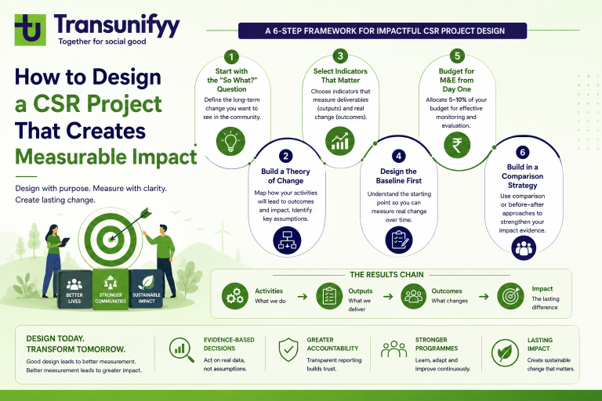
Start with the "So What?" Question
Before writing a single line of the project proposal, answer this: "If this programme works exactly as planned, what will be different in these communities three years from now?"
Not "what activities will we run" — that's the how. Not "what will we deliver" — that's the output. The question is about change. Behaviour change. Income change. Health outcomes. Migration patterns.
A tribal livelihood programme might answer: "Families that currently depend on single-season rainfed agriculture will have year-round irrigation, multi-season cropping, and household incomes above the district median."
That's a testable statement. You can measure it. And it shapes everything that follows.
Build a Theory of Change Before Building a Budget
A Theory of Change (ToC) is a map of how your activities are expected to lead to outcomes and eventually impact. It makes the causal logic explicit:
If we construct group wells and provide irrigation infrastructure (activities), then farmers will irrigate additional land (outputs), which means cropping intensity will increase and incomes will rise (outcomes), contributing to food security and elimination of distress migration (impact).
Why does this matter for measurability? Because the ToC tells you exactly what to measure at each stage. Without it, you're guessing which indicators matter. With it, your M&E framework writes itself.
A good ToC also surfaces your assumptions — the things that must be true for your logic to hold. "Groundwater is available at excavation depth." "Farmers have the skills to cultivate Rabi crops." "Market access exists for the additional produce." Each assumption is a risk. And each risk should have a monitoring indicator.
Select Indicators That Tell You Something Useful
Most CSR project logframes are stuffed with indicators that are easy to count but hard to learn from. "Number of training sessions conducted" tells you nothing about whether anyone learned anything. "Number of toilets constructed" tells you nothing about whether anyone uses them.
For every indicator, apply this test: "If this number goes up, does it definitely mean the programme is working?" If the answer is "not necessarily," you need a better indicator.
Output indicators should track deliverables: wells constructed, people trained, enterprises established. These confirm that the programme is doing what it said it would do.
Outcome indicators should track change: irrigated area per household, income from new crops, toilet usage rate, dietary diversity score. These confirm that the deliverables are actually making a difference.
Keep the total number of indicators manageable. A programme with 50 indicators measures nothing well. A programme with 12 carefully chosen indicators measures everything that matters.
Design the Baseline Before You Start
This is where most CSR programmes make their biggest mistake: they start implementation without collecting baseline data, then three years later hire an evaluator who asks "what was the situation before the project?" and gets blank stares.
A baseline is a snapshot of the situation before your programme intervenes. Without it, you cannot measure change — only the current state. And the current state, on its own, tells you nothing about whether your programme caused it.
The baseline doesn't need to be a massive research exercise. A well-designed survey of 100–200 beneficiary households, covering your key outcome indicators, conducted before or in the first month of implementation, gives you everything you need for a credible before-after comparison at endline.
If the programme has already started and no baseline exists, you have two imperfect options: (1) Use recall questions in your endline survey ("What was your income before the project?"), or (2) Use secondary data (Census, SECC, NFHS) as a proxy baseline. Both have limitations, but both are better than nothing.
Budget for M&E from Day One
A common pattern: the project budget allocates 95% to implementation and 5% (or nothing) to monitoring and evaluation. Then at year three, everyone scrambles to find money for an impact assessment.
Industry benchmark: allocate 5–10% of the total project budget to M&E. This covers baseline data collection, ongoing monitoring systems, mid-term review and endline evaluation. For a ₹2 Crore programme, that's ₹10–20 Lakh — a small investment for evidence that your ₹1.8 Crore in implementation actually worked.
Build in a Comparison Strategy
The gold standard for impact measurement is comparing your beneficiaries with a similar group that didn't receive the programme. This "counterfactual" tells you what would have happened without your intervention.
For most CSR programmes, a full randomised control trial isn't feasible. But a quasi-experimental design — carefully selecting comparison villages that are similar to your project villages on key characteristics — is entirely practical and dramatically strengthens your impact evidence.
Even if a formal comparison group isn't possible, design your M&E to capture before-after changes with enough rigour to make a credible case. A well-documented Theory of Change, solid baseline and systematic endline with triangulated data sources can support "contribution analysis" — demonstrating that your programme plausibly contributed to the observed changes.
The Payoff: Credibility and Learning
A CSR programme designed for measurability produces two things that programmes designed only for activity cannot: credibility with stakeholders and learning for the organisation.
Credibility means your annual report goes beyond "we spent ₹3 Crore across 5 thematic areas." It says "household food security improved from 45% to 88% among beneficiaries, with cropping intensity reaching 153% — among the highest in the state for groundwater-irrigated tribal areas." That's a sentence that earns the next round of CSR funding.
Learning means you know what worked and what didn't — not as an opinion, but as evidence. The livestock component had complete herd loss in two villages? Now you know to build veterinary infrastructure before distributing animals. That insight is worth far more than the cost of measuring it.
Looking to strengthen your programme monitoring or impact measurement systems? Transunifyy works with NGOs, CSR teams and foundations across India to design evaluation frameworks, conduct impact assessments, build digital monitoring systems and generate evidence for stronger social impact.
Connect with us to explore how we can support your organisation.