What are impact assessment services and why are they critical for CSR and NGOs?
Impact assessment services help organisations measure whether their social programmes actually created meaningful change. Not what was spent. Not what activities were conducted. But what changed in the lives of beneficiaries because of the intervention.
In India, where corporates spend over ₹26,000 crore annually on CSR and thousands of NGOs implement development programmes across every state, the demand for credible impact assessment has grown sharply. Boards want to see Social Return on Investment. Donors want evidence that their funding created outcomes, not just outputs. Regulators are tightening disclosure requirements. And the Social Stock Exchange now requires standardised impact reporting for listed organisations.
Yet most CSR programmes and NGOs still measure success by counting outputs — number of people trained, toilets built, health camps conducted. These numbers confirm that activities happened. They say nothing about whether anything changed.
Impact assessment services bridge this gap through rigorous methodologies including SROI analysis, baseline-endline studies, Theory of Change development, outcome mapping, programme evaluation, and impact reporting. This guide covers what each methodology involves, when to use it, and how to build impact measurement into your programme from day one.
SROI analysis — putting a value on social impact
Social Return on Investment analysis is the most powerful tool for communicating social impact to corporate boards, foundation trustees, and investors. It answers the question every stakeholder ultimately asks: for every rupee invested, how much social value was created?
SROI methodology involves mapping the complete chain from inputs and activities to outputs, outcomes, and impact for every stakeholder group. Financial proxies are then applied to social outcomes — the monetary value of improved health, increased income, time saved, reduced vulnerability. The SROI ratio compares the total social value created against the total investment made.
An SROI ratio of 3.2 means that for every ₹1 invested, ₹3.20 of social value was generated. This is the language boards understand. This is what CSR annual reports need.
SROI analysis is also increasingly required for organisations preparing to list on India's Social Stock Exchange, for ESG and BRSR disclosures, and for CSR programmes seeking to demonstrate value beyond compliance spending.
When to use SROI: At programme completion or at major milestones when you need to demonstrate return on investment to stakeholders. Also valuable for comparing the relative value of different programme models.
What you need: Baseline data from programme commencement, outcome data from implementation tracking, and financial records of programme expenditure. Without baseline data, SROI calculations require retrospective estimation which reduces rigour.
Baseline, midline, and endline studies
Baseline-endline studies are the foundation of credible impact measurement. A baseline captures conditions before the programme begins. An endline captures conditions after the programme concludes. The difference tells you what changed.
A well-designed baseline study involves developing a statistically robust sampling framework appropriate for the programme context and geography, conducting household or individual surveys using trained enumerators with mobile data collection tools, collecting both quantitative data on measurable indicators and qualitative data through focus group discussions and key informant interviews, and establishing reference points for every outcome indicator the programme intends to influence.
Midline studies conducted midway through implementation provide early evidence of whether the programme is on track or needs course correction. This is where many programmes discover that their implementation model needs adjustment — a finding that comes too late if you wait until the endline.
The biggest mistake organisations make: Starting implementation without collecting baseline data. Without knowing where you started, you cannot measure how far you have come. Retroactive baseline estimation is possible through recall questions and secondary data, but it is significantly less rigorous than prospective baseline collection.
How technology helps: Platforms like Transunifyy enable baseline data collection through mobile apps with offline support and voice-to-text in regional languages. Field teams can conduct household surveys in remote villages, capture geo-tagged evidence, and have data flow directly into dashboards — eliminating the weeks of manual data entry that traditional baseline studies require.
Monitoring and evaluation frameworks for CSR programmes
A Monitoring, Evaluation, and Learning framework is the system that connects programme design to impact evidence. Without a structured M&E framework, organisations collect data ad hoc, measure what is easy rather than what matters, and arrive at evaluation time with gaps that cannot be filled.
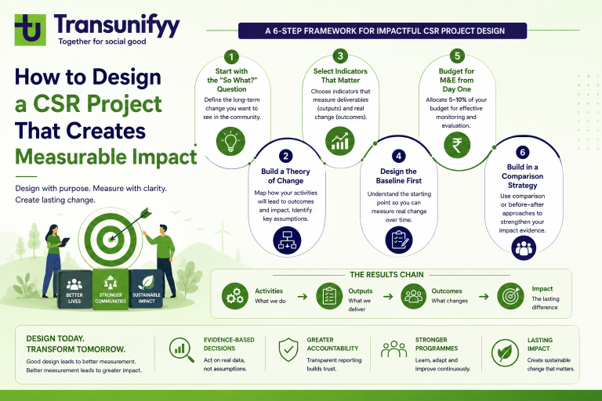
Designing an effective M&E framework involves several interconnected steps. First, developing a Theory of Change that maps the causal pathway from activities to outputs to outcomes to long-term impact. The Theory of Change makes explicit the assumptions underlying the programme and identifies what needs to be measured at each stage.
Second, defining indicators at each level of the results chain. Output indicators track what was delivered. Outcome indicators track what changed. Impact indicators track whether the change was sustained and systemic. Each indicator needs a clear definition, data source, collection frequency, and responsibility assignment.
Third, establishing data collection protocols that field teams can actually follow. The most sophisticated M&E framework is worthless if field workers cannot or do not collect the data it requires. Protocols must be realistic given the team's capacity, connectivity constraints, and workload.
Fourth, creating dashboards and reporting systems that convert raw data into actionable intelligence. Programme managers need to see progress against indicators in real-time, not in a quarterly report that arrives three weeks late.
Fifth, building learning loops so that monitoring data feeds back into programme design improvements. M&E should not be a compliance exercise. It should be a tool for continuous programme improvement.
Where most M&E frameworks fail: They are designed by consultants, documented in a PDF, and never operationalised. The logframe sits in a folder. Field teams continue collecting data on Excel. The M&E framework and actual monitoring exist in parallel universes.
The fix: Use NGO management software like Transunifyy where the M&E framework is built directly into the project tracking system. Indicators are embedded in the dashboard. Data collection happens through the same mobile app field teams use for daily reporting. Outcome tracking is not a separate activity — it is part of the operational workflow.
Programme evaluation services
Mid-term and end-of-programme evaluations provide a comprehensive assessment of what worked, what did not, and why. They go deeper than routine monitoring by examining effectiveness, relevance, efficiency, impact, and sustainability.
Formative evaluations conducted during early implementation enable course correction before significant resources are committed to an approach that is not working. Summative evaluations at programme completion assess overall effectiveness and generate evidence for future programming decisions.
Process evaluations examine how programmes are being implemented — whether the implementation model matches the design, where adaptations were made, and whether those adaptations improved or weakened outcomes. Thematic evaluations focus on specific cross-cutting issues like gender inclusion, sustainability, or scalability.
Good evaluation practice uses mixed methods — combining quantitative survey data with qualitative interviews, focus groups, case studies, and participatory assessments. Numbers tell you what changed. Stories tell you how and why.
Outcome mapping — measuring change beyond outputs
Traditional M&E counts outputs. Outcome mapping tracks changes in behaviour, practices, relationships, and systems among the people and organisations a programme works with.
Outcome mapping is particularly valuable for programmes in complex sectors like governance, gender equality, institutional strengthening, and behaviour change communication — where counting outputs alone fails to capture the real impact of the work.
The methodology defines boundary partners, establishes progress markers showing gradual movement toward desired changes, and designs data collection methods appropriate for tracking behavioural and systemic change.
When to use outcome mapping: When your programme's success depends on changes in how people or organisations behave, not just on what services they received.
Social Stock Exchange readiness advisory
India's Social Stock Exchange is creating a new pathway for NGOs and social enterprises to raise capital by demonstrating measurable social impact. Listing on the SSE requires meeting SEBI's standards for impact disclosure, governance, and reporting.
SSE readiness advisory helps organisations understand eligibility criteria and the 67% social intent test, prepare Annual Impact Reports meeting SEBI disclosure standards, establish impact measurement frameworks for ongoing compliance, set up governance and reporting systems for continuous disclosure, and build the evidence base required for social auditor assessment.
The recent CSR regulatory amendments permitting companies to invest up to 10% of their CSR obligation through SSE-listed ZCZP instruments have made SSE readiness increasingly relevant for NGOs seeking access to institutional CSR funding.
Impact of DPDPA on CSR programmes and NGOs
The Digital Personal Data Protection Act 2023 has significant implications for how NGOs and CSR programmes collect, store, and process beneficiary data. Organisations managing large beneficiary databases with demographic information, Aadhaar details, health records, and income data must now ensure compliance with DPDPA requirements.
Key areas where DPDPA affects social sector operations include obtaining informed consent from beneficiaries before collecting personal data, implementing data minimisation principles so only necessary data is collected, ensuring secure storage and access controls for beneficiary databases, establishing clear data retention and deletion policies, and documenting data processing purposes for each category of personal information collected.
For CSR programmes that share beneficiary data between corporates and implementing NGO partners, data processing agreements and clear accountability frameworks become essential.
Organisations using digital platforms for beneficiary management should ensure their technology provider is DPDPA compliant. Transunifyy's platform is designed with data protection principles built in — role-based access controls, audit trails, and secure data handling that align with DPDPA requirements.
Building impact measurement into your programme from day one
The most important thing about impact assessment is this: it cannot be an afterthought. You cannot design a programme, implement it for three years, and then hire an evaluator to find out if it worked. By that point, there is no baseline data, no systematic outcome tracking, and no evidence trail.
Impact measurement must be designed into the programme from day one. This means collecting baseline data before or during the first month of implementation. It means defining outcome indicators at the programme design stage. It means building data collection into field team workflows rather than treating it as a separate burden. It means using technology platforms that track outcomes continuously rather than annually.
Transunifyy's platform enables this by integrating M&E into project management. Baseline data is captured through the mobile app during the first field visits. Outcome indicators are tracked throughout implementation as part of routine project monitoring. SROI is calculated from the same data that flows through the project dashboard. When the evaluation is needed, the evidence is already there.
Who needs impact assessment services
Corporates wanting to measure the real impact of their CSR programmes beyond expenditure reporting and demonstrate SROI to their boards and stakeholders.
NGOs needing to demonstrate impact to existing donors, attract new funding, or prepare for Social Stock Exchange listing.
Foundations requiring portfolio-level impact analysis across multiple grantee partners to inform strategic grant-making decisions.
Social enterprises preparing for SSE listing, impact investment, or SEBI compliance requirements.
Government agencies evaluating the effectiveness of public welfare and development programmes.
Transunifyy provides comprehensive impact assessment services including SROI analysis, baseline-endline studies, M&E framework design, programme evaluation, and SSE readiness advisory. Our team combines 20+ years of field experience with AI-powered analytics. Connect with us to discuss your assessment needs or register free on our platform to strengthen your impact measurement systems.