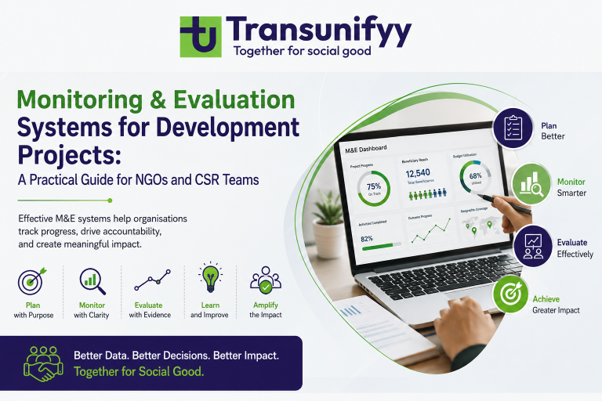
As the new financial year progresses, several CSR and development projects have already moved from planning to implementation. Activities are being rolled out, communities are being reached and funds are being deployed.
However, one critical question often remains unanswered:
How do we know whether the project is progressing as planned and creating the intended outcomes?
This is where a robust Monitoring and Evaluation (M&E) system becomes indispensable.
An effective M&E system is not merely a reporting requirement. It is a management tool that enables organisations to make informed decisions, improve programme effectiveness, demonstrate accountability and measure change. More importantly, it helps organisations move from reporting activities undertaken to understanding outcomes achieved and learning generated.
Why is an M&E System Important?
A well-designed M&E system helps organisations:
- Track project progress against planned activities and milestones
- Monitor fund utilisation and implementation efficiency
- Measure outputs and outcomes systematically
- Generate evidence for learning and decision-making
- Strengthen accountability towards communities and funders
- Facilitate timely course corrections and adaptive management
- Demonstrate measurable and sustainable impact
Projects that lack an M&E framework often struggle with fragmented data, delayed reporting, inconsistent indicators and difficulties in demonstrating results and learning.
What Should Organisations Put in Place?
Step 1: Clearly Define the Theory of Change
Every project begins with a vision of change. However, unless this pathway is clearly articulated, measuring progress becomes difficult.
Organisations should clearly map:
Problem → Activities → Outputs → Outcomes → Long-term Impact
A Theory of Change helps teams understand how project interventions are expected to create change and provides the foundation for designing an effective monitoring framework.
Step 2: Develop a Logical Framework and Indicators
Once the Theory of Change is defined, organisations should establish a clear results framework and identify indicators at different levels.
Indicators may include:
- Input Indicators: Resources invested in the project
- Output Indicators: Activities delivered and services provided
- Outcome Indicators: Changes in knowledge, behaviour, practices or conditions
- Impact Indicators: Long-term social, economic or environmental changes
Indicators should ideally be:
Specific, Measurable, Achievable, Relevant and Time-bound (SMART).
Clearly defined indicators ensure consistency in measurement and enable organisations to track progress meaningfully.
Step 3: Establish Baselines and Targets
One of the most common gaps in development projects is the absence of baseline information.
Organisations should clearly establish:
- Where are we today?
- What change do we want to achieve?
- By when do we want to achieve it?
Baselines provide the starting point, while targets provide the desired destination. Together, they create the reference points against which progress and outcomes can be measured.
Step 4: Develop Data Collection and Reporting Systems
An M&E framework is only effective if robust systems exist to generate reliable information.
Organisations should clearly define:
- What data will be collected?
- How frequently will it be collected?
- Who will collect the data?
- What tools will be used?
- How will data quality be ensured?
Data collection systems should be practical, standardised and aligned with reporting requirements of donors and project stakeholders.
Step 5: Design Monitoring Dashboards and Reporting Mechanisms
Monitoring should not be restricted to periodic reports. Decision-makers require real-time visibility into project progress.
Dashboards should ideally track:
- Beneficiary reach and coverage
- Activity progress against plans
- Geographic implementation status
- Budget utilisation and fund disbursements
- Output and outcome achievement
- Key performance indicators (KPIs)
- Reporting and compliance status
Dashboards help programme teams identify implementation gaps and enable evidence-based decision-making.
Step 6: Build Capacities and Allocate Resources for M&E
An M&E system is only as effective as the people, processes and resources that support it. Establishing indicators and dashboards alone is insufficient if organisations do not invest in the capacities and systems required to operationalise them.
Budget for M&E
Monitoring and Evaluation should be treated as an integral project function rather than an overhead expense. Project proposals and budgets should clearly provide for:
- Baseline, midline and endline assessments
- Data collection and field monitoring activities
- Monitoring visits and review meetings
- Data management and reporting systems
- Dashboard and technology requirements
- Capacity building and training initiatives
- Third-party evaluations and impact assessments, where applicable
Allocate Dedicated Resources
Clearly define roles and responsibilities for data collection, verification, analysis and reporting. Depending on the scale of the project, organisations may consider appointing dedicated M&E personnel or assigning monitoring responsibilities within programme teams.
Build Staff Capacities
Field teams and programme staff should receive regular training on:
- Data collection methodologies and tools
- Indicator definitions and measurement protocols
- Data quality standards and verification processes
- Ethical considerations, confidentiality and informed consent
- Reporting requirements and documentation standards
- Using data for adaptive management and decision-making
Ultimately, investing in people and systems ensures that Monitoring and Evaluation becomes an enabler of learning and evidence-based decision-making rather than merely a reporting exercise.
Step 7: Build Data Quality Assurance Mechanisms
Monitoring systems are only as reliable as the data that supports them.
Organisations should establish mechanisms for:
- Data validation and verification
- Standard operating procedures and protocols
- Periodic data quality audits
- Documentation and evidence management
- Supervisory reviews and field verification
High-quality data strengthens credibility and improves the quality of reporting and decision-making.
Step 8: Create Learning and Review Mechanisms
Monitoring should not end with reporting. The real value of M&E lies in generating insights and improving programme effectiveness.
Organisations should periodically ask:
- What is working well?
- What is not working?
- Why are certain targets not being achieved?
- What corrective actions are required?
- What lessons can be incorporated into future planning?
The ultimate purpose of Monitoring and Evaluation is continuous learning, adaptive management and improved impact.
Common Challenges We Frequently Observe
Through our work with NGOs, CSR foundations, and development institutions, we frequently observe:
- Indicators that are not clearly defined
- Absence of baseline data and targets
- Manual and fragmented reporting systems
- Limited visibility on project progress
- Inconsistent outcome measurement approaches
- Insufficient M&E budgets and dedicated resources
- Inadequate capacities for data collection and analysis
- Difficulty in generating timely reports and dashboards
- Challenges in consolidating data across multiple locations
These challenges often result in organisations spending significant time reporting activities but struggling to demonstrate outcomes and impact.
How Technology Can Strengthen M&E Systems
Technology can significantly improve Monitoring and Evaluation by enabling:
- Real-time project tracking
- Digital beneficiary management systems
- Automated dashboards and reporting
- KPI monitoring and alerts
- Geographic and thematic analytics
- Document management and compliance tracking
- Centralised data repositories
- Improved collaboration among project stakeholders
When supported by robust processes and domain expertise, technology can transform M&E from a reporting exercise into a strategic management function.
Final Thoughts
An effective Monitoring and Evaluation system is not an additional administrative layer, it is the foundation for evidence-based decision-making, accountability, learning and sustainable impact.
The most successful M&E systems are not necessarily the most sophisticated; they are the ones that are adequately resourced, supported by trained teams and embedded into day-to-day programme management and decision-making processes.
As development challenges become increasingly complex and stakeholders demand greater accountability and measurable outcomes, organisations that invest in robust M&E systems today will be better positioned to demonstrate impact, attract partnerships and scale sustainable change tomorrow.
Looking to design or strengthen your Monitoring & Evaluation systems?
Connect with us at www.transunifyy.com or write to us at contact@transunifyy.com to explore how our domain experts and integrated project management platform can help your organisation build robust, data-driven and impact-oriented Monitoring and Evaluation systems.
You can also download our free M&E System Setup Toolkit for practical templates and guidance to get started.