Introduction
March is the most stressful month for many NGOs.
Utilisation certificates are pending. Donors are asking for reports. Activities need to be completed before the financial year ends.
But here is the uncomfortable truth: Many NGOs do not struggle with impact. They struggle with fund management systems.
Common Problems That Surface During Audits and Impact Assessments
- Budget vs Actual not reviewed monthly
- Documentation missing for activities
- Cash flow gaps during projects
- Spending not linked to outputs or beneficiaries
- Weak internal financial controls (procurement checks, approvals, maker-checker systems)
Good fund utilisation is not about spending fast. It is about spending responsibly, documenting properly and linking money to outcomes.
Over the next few posts, we will share a practical 5-pillar framework for NGO fund management, starting with:
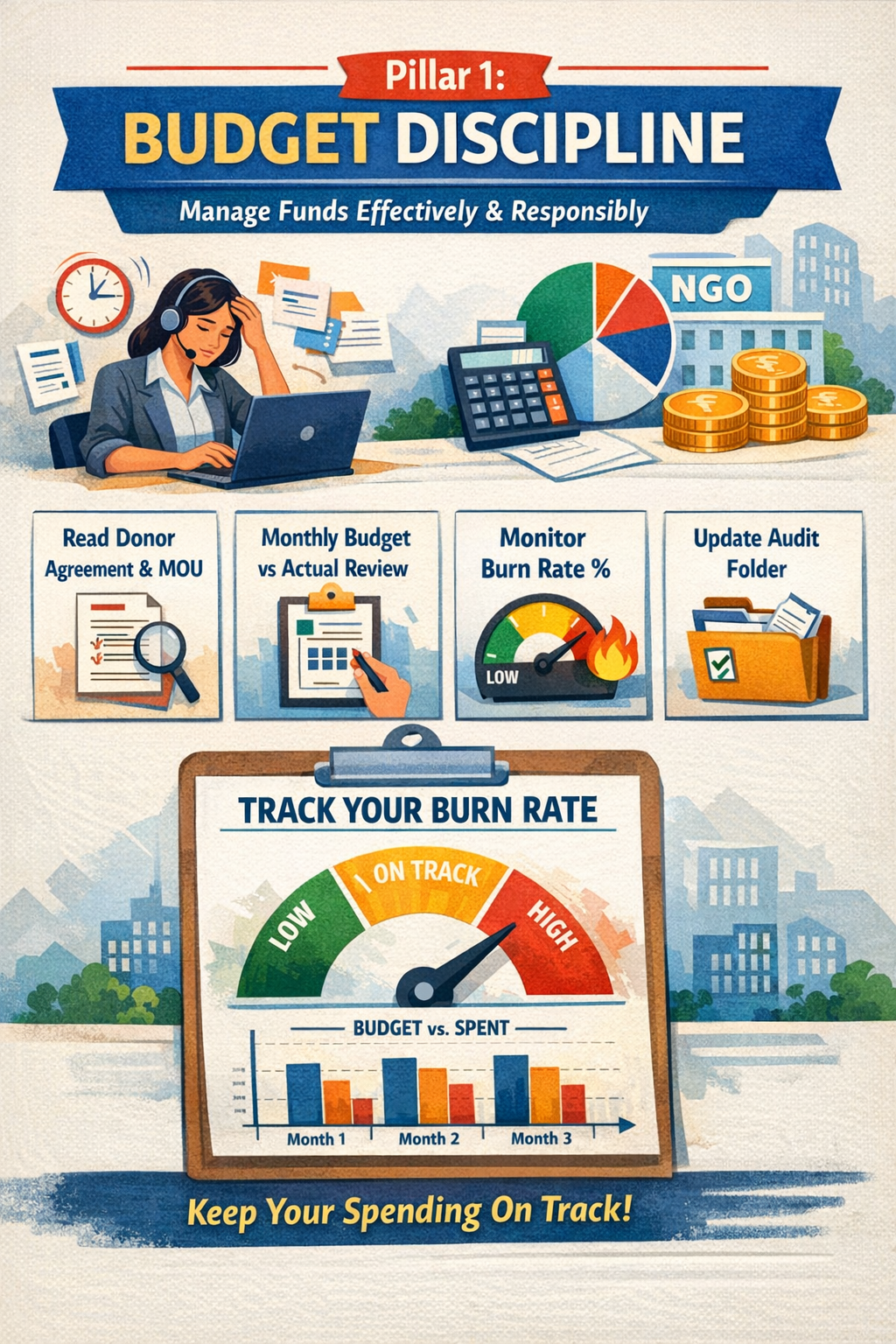
Pillar 1: Budget Discipline
Read donor agreement & MOU carefully — Understand budget heads, permissible expenses, and reporting timelines before spending begins.
Create a budget-head tracking sheet — Map every expense to a budget line item from Day 1. This avoids last-minute reconciliation headaches.
Hold monthly Budget vs Actual review meetings — Do not wait for the auditor to tell you there is a variance. Catch it early and course-correct.
Monitor burn rate vs timeline percentage — If 60% of the project timeline has passed but only 30% of the budget is utilised, that is a red flag. Conversely, if spending is ahead of schedule, check whether activities are genuinely complete or funds are being rushed out.
Keep the audit folder updated monthly — Vouchers, approvals, bank statements, and supporting documents should be filed as you go, not compiled in March.
Understanding Burn Rate
One of the simplest ways to maintain budget discipline in a project is to track the Burn Rate.
Burn Rate tells you how fast you are spending relative to the project timeline. It is calculated as:
Burn Rate (%) = (Amount Spent to Date ÷ Total Budget) × 100
Compare this with the Timeline Progress (%):
Timeline Progress (%) = (Months Elapsed ÷ Total Project Duration) × 100
When the burn rate and timeline progress are aligned, your project is on track. Significant deviations in either direction warrant immediate review and corrective action.
Download the Free Budget Utilisation Tracker
We have created a practical, ready-to-use Budget Utilisation Tracker template that helps you monitor budget heads, actual spending, variance, and burn rate at a glance. Download it using the link in the sidebar.
Looking Ahead
If you work in an NGO or CSR project, this series will help you close the current financial year smoothly and prepare stronger systems for the next one.
Let us build NGOs that are not only impactful but also financially credible.
Stay tuned for Pillar 2 in the next post.