"We trained 500 women in tailoring."
Is that an output, an outcome, or an impact? If you hesitated, you're not alone. This is the single most misunderstood concept in CSR monitoring, and getting it wrong doesn't just cause confusion in reports — it fundamentally distorts how programmes are designed, measured and improved.
Let's sort this out properly.
The Results Chain, Explained Simply
Every development programme follows a causal chain, whether it's explicit or not:
Inputs → Activities → Outputs → Outcomes → Impact
Think of it as a story:
- Inputs are what you invest: money, staff, equipment, time. "₹45 Lakh allocated for maternal health programme" is an input.
- Activities are what you do with those inputs: training sessions, construction, distribution drives. "Conducting immunisation drives in 30 villages" is an activity.
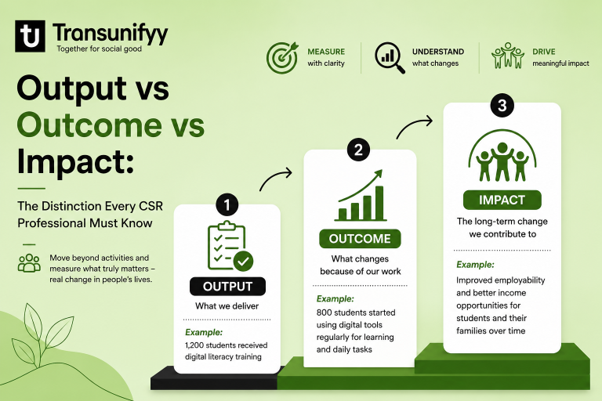
- Outputs are what you deliver — the direct, countable products of your activities. "450 pregnant women received antenatal check-ups" is an output.
- Outcomes are the changes that happen because of your outputs: changed behaviour, improved knowledge, better access. "Institutional delivery rate increased from 42% to 78%" is an outcome.
- Impact is the long-term, systemic transformation that your programme contributes to. "Infant mortality rate reduced from 52 to 28 per 1,000 live births over 5 years" is an impact.
Now, back to our opening question: "We trained 500 women in tailoring." That's an output — you delivered training to 500 people. You can count it. It's done.
But did those women actually start earning? That's the outcome. Did their households sustainably move out of poverty? That's the impact.
Why This Distinction Matters So Much
When CSR programmes report outputs as impact, three things go wrong:
Programme design suffers: If you measure success by "number of toilets built" (output), you'll build more toilets. But if 30% of those toilets are being used as storage rooms because no one conducted behaviour change communication, you've wasted resources. Measuring outcomes — actual toilet usage — would have flagged the gap early enough to fix it.
Donor reporting becomes misleading: Annual CSR reports filled with "500 trained, 100 wells built, 200 saplings planted" tell the board nothing about whether the programme worked. Did the trained women get jobs? Did the wells improve crop yields? Did the saplings survive? Without outcome data, CSR spending looks productive but might not be.
Future programmes repeat the same mistakes: If you never measure whether your livestock intervention actually increased household income (outcome) or just delivered goats (output), you'll keep designing livestock programmes the same way — even if the model isn't working.
Real-World Examples That Make the Distinction Stick
Let's use a CSR-funded irrigation programme as an example:
| Level | Example |
|---|---|
| Input | ₹3.5 Lakh invested per group well including pump and pipeline |
| Activity | Constructing wells and installing motorised pump systems |
| Output | 100 group wells constructed serving 500 farmer families |
| Outcome | Cropping intensity increased from single-season to 153% |
| Impact | Elimination of distress migration due to year-round water availability |
Notice how each level answers a different question:
- Input: What did we invest?
- Activity: What did we do?
- Output: What did we produce?
- Outcome: What changed?
- Impact: What lasted?
The Tricky Grey Zones
In practice, the hardest distinction is between outcome and impact. Here's a useful test:
Outcome is a change that your programme directly influenced in the short-to-medium term. You can reasonably attribute it to your intervention. "Households with access to safe drinking water increased from 40% to 95%."
Impact is a broader, longer-term shift that your programme contributed to alongside many other factors. You can claim contribution, not sole attribution. "Waterborne disease incidence reduced by 70% over five years."
The difference is both temporal (outcomes are sooner, impact is later) and causal (outcomes are more directly attributable, impact has multiple contributing factors).
A Practical Test for Your Next CSR Report
Go through your most recent CSR annual report and for every metric reported, ask:
- Can I count this directly after the activity? → Probably an output.
- Did something change in people's behaviour, knowledge or conditions? → That's an outcome.
- Is this a sustained, systemic shift that will outlast the programme? → That's impact.
If your report is 80% outputs with no outcomes or impact data, you have a measurement gap — not necessarily a programme gap. The programme might be working beautifully. You just aren't measuring the right things to prove it.
How to Actually Measure Outcomes and Impact
This is where it gets harder — and where many CSR programmes stop. Counting outputs is easy. Measuring change requires:
Baseline data. You can't measure change without knowing where you started. If you didn't collect baseline data before the programme, you'll need to reconstruct it through recall questions or secondary data during the evaluation. It's imperfect, but better than nothing.
Comparison. The ideal: a control group of similar people who didn't receive the programme. The practical alternative: before-after comparison within your beneficiary group, with appropriate caveats.
Time. Outcomes need 1–2 years to manifest. Impact needs 3–5 years. Measuring "impact" six months into a livelihood programme is like checking crop yield the day after planting.
The Bottom Line
Outputs tell you what you did. Outcomes tell you if it worked. Impact tells you if it mattered. All three are important — but if your CSR reporting stops at outputs, you are telling only a third of the story.
Looking to strengthen your programme monitoring or impact measurement systems? Transunifyy works with NGOs, CSR teams and foundations across India to design evaluation frameworks, conduct impact assessments, build digital monitoring systems and generate evidence for stronger social impact.
Connect with us to explore how we can support your organisation.