Introduction
For years, NGOs have relied on grants, CSR partnerships, philanthropy and institutional donors to fund social impact initiatives. However, fundraising often remained fragmented, relationship-driven and limited to a small network of donors.
The emergence of India's Social Stock Exchange (SSE), regulated by SEBI and hosted on the BSE and NSE platforms, is changing this landscape by bringing transparency, accountability and capital-market discipline to social funding.
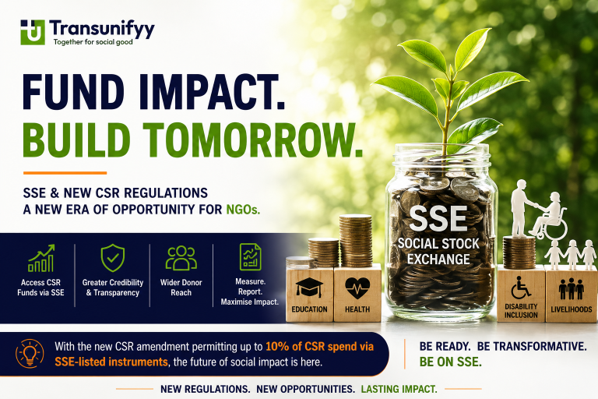
The recent CSR regulatory amendments have further strengthened the role of SSE by permitting companies to invest a portion of their CSR budgets through SSE-listed instruments, creating a new opportunity for eligible NGOs to access institutional funding.
This article explains what has changed, why it matters, and how NGOs can prepare themselves.
Understanding the Social Stock Exchange
The Social Stock Exchange is a dedicated segment of the Bombay Stock Exchange (BSE) and National Stock Exchange (NSE) designed to connect social enterprises and non-profit organisations with donors and impact-focused investors.
Unlike conventional stock exchanges, there are no share prices, no trading gains, and no speculation. Instead, funds are raised for social impact, impact reporting is mandatory, and transparency and accountability are built into the system.
The SSE provides a regulated mechanism through which NGOs can raise funds while giving donors greater visibility into how funds are utilised and what impact is achieved.
The big change: new CSR regulations
One of the most significant developments for the social sector is the government's decision to allow companies to invest up to 10% of their annual CSR obligation through SSE-listed Zero Coupon Zero Principal (ZCZP) instruments.
This means corporate CSR budgets can now flow through SSE, NGOs gain access to a new pool of institutional funding, companies can diversify their CSR portfolio, and funding decisions become more transparent and impact-driven.
For NGOs, this amendment opens the possibility of attracting CSR funding through a regulated fundraising platform rather than relying solely on direct corporate partnerships.
Expansion of eligible activities
Another major development is the alignment of SSE eligibility with Schedule VII of the Companies Act.
Previously, NGOs had to demonstrate alignment with SEBI's prescribed social activity categories. Now, activities covered under Schedule VII of CSR are also eligible, significantly widening the universe of NGOs that can register on SSE.
This includes organisations working in education, healthcare, water and sanitation, livelihoods, skill development, environment and climate action, gender equality, persons with disabilities, rural development, disaster management, and heritage and culture.
The amendment has effectively brought most mainstream development-sector NGOs within the ambit of SSE eligibility.
What is a ZCZP instrument?
The primary fundraising instrument available to NGOs on SSE is the Zero Coupon Zero Principal (ZCZP) Instrument.
In simple terms, the donor contributes funds, the NGO receives the funds, there is no repayment obligation, there is no interest payment, and the contribution functions as a regulated donation.
Key parameters include a minimum issue size of ₹50 Lakhs, minimum investment of ₹1,000 for retail investors, dematerialised format, no trading permitted, and a fundraising window of 3 to 10 days.
Why NGOs should consider SSE
Access to new funding sources — SSE enables NGOs to reach CSR contributors, institutional donors, family offices, high net worth individuals, and retail donors through a common regulated platform.
Enhanced credibility — Registration and listing on BSE or NSE Social Stock Exchange signal that the organisation has met regulatory and disclosure requirements. This often increases donor confidence and organisational credibility.
Standardised impact reporting — SSE encourages NGOs to adopt stronger monitoring, evaluation and impact measurement systems. This leads to better accountability and improved communication with stakeholders.
Increased visibility — Listing enables NGOs to showcase their work to a much wider audience than traditional fundraising channels.
Is your NGO eligible?
To register on SSE, NGOs generally need to meet requirements across several areas.
Legal requirements include being registered as a Trust, Society or Section 8 Company with valid registration for at least 12 months.
Operational requirements include minimum 3 years of operations and a demonstrated social impact track record.
Tax compliance requires 12A or 12AB registration, 80G registration, and Income Tax Returns filed for the last 3 years.
Financial thresholds include annual expenditure of at least ₹50 lakh in the last financial year and minimum ₹10 lakh raised through grants or donations.
Governance requirements include NGO Darpan registration, PAN and TAN, audited financial statements for the last 3 years, and board approval for SSE registration.
What NGOs need to prepare before registering
SSE is not merely a fundraising platform — it is also a transparency platform. NGOs should assess several areas of readiness.
Organisational readiness — Are activities aligned with SSE and CSR objectives?
Documentation readiness — Are registrations, audits and statutory filings up to date?
Monitoring and evaluation systems — Can the organisation measure and report outputs, outcomes and impact?
Leadership commitment — Is senior management prepared to engage with donors and meet ongoing compliance requirements?
Post-listing responsibilities
Listing on SSE brings continuous disclosure obligations.
Annual Impact Report — Audited impact reporting demonstrating utilisation and outcomes.
Organisational disclosures — Governance, financial and operational disclosures on an ongoing basis.
Quarterly fund utilisation statements — Updates on use of funds raised through the exchange.
Material event reporting — Disclosure of significant events affecting the organisation.
The road ahead
India's Social Stock Exchange is still in its early stages, but recent regulatory changes indicate strong policy support for integrating social impact with capital markets. With CSR funds now permitted through SSE and Schedule VII activities brought within its scope, the platform has the potential to become a significant fundraising channel for credible and impact-oriented NGOs.
For organisations that already have strong governance, financial discipline and monitoring systems, SSE represents more than a compliance exercise — it is an opportunity to build credibility, attract new funding and demonstrate impact at scale.
Conclusion
The question is no longer whether SSE will become relevant for NGOs. The real question is: Is your organisation ready for a future where fundraising, impact measurement, transparency and compliance are increasingly interconnected?
For NGOs seeking long-term sustainability and access to institutional funding, now may be the right time to begin assessing their SSE readiness and preparing for this evolving ecosystem.
Transunifyy offers SSE readiness advisory, impact assessment, SROI analysis, and AI-powered monitoring and reporting systems to help NGOs prepare for Social Stock Exchange listing. Connect with us to assess your readiness or register free on our platform to strengthen your impact measurement systems.