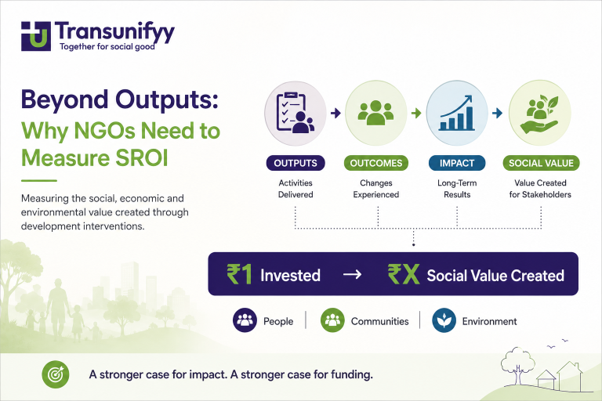
For years, NGOs have measured progress through numbers
How many trainings were conducted. How many households were reached. How many assets were created. How many beneficiaries participated.
These numbers are important but they tell only part of the story.
Today, funders, CSR leaders and communities are asking a deeper question: What changed because of the investment?
Did incomes improve? Did access to water increase productivity? Did women gain stronger decision-making roles? Did livelihoods become more resilient?
This is where Social Return on Investment (SROI) becomes relevant.
What is SROI?
Social Return on Investment (SROI) is a framework used to understand and measure the social, economic and environmental value created through a programme or investment.
In simple terms, it helps answer: For every ₹1 invested, how much social value was created?
For example, a watershed project may create value through improved groundwater recharge, increased crop productivity, reduced irrigation costs, higher farm income, and stronger livelihood resilience. SROI helps organisations capture this broader value and not just project spending or activity completion.
Why NGOs need to look beyond outputs
Most project reports focus on outputs: 500 farmers trained, 20 water structures constructed, 300 youth certified. These show what was delivered. But they do not fully explain what changed because of it.
SROI helps bridge that gap.
| Level | Example |
|---|---|
| Output | Farmers trained on improved irrigation |
| Outcome | Farmers adopted water-efficient practices |
| Impact | Reduced water use and improved productivity |
| Social Value | Increased income and resilience over time |
This shift from reporting activities to measuring value is becoming essential across the development sector.
Why SROI matters today
SROI is gaining importance because organisations are increasingly expected to demonstrate outcomes, not just expenditure. It helps NGOs and CSR teams communicate impact with stronger evidence, understand which interventions create greater value, strengthen donor and board reporting, improve strategic decision-making, and prioritise investments more effectively.
Most importantly, it helps organisations understand what matters most to stakeholders and what change is truly being created.
How SROI strengthens fundraising
Beyond measurement and reporting, SROI can also become a valuable tool for fundraising. Today, funders increasingly look beyond activity completion and budget utilisation — they want to understand the outcomes and long-term value created through their support. NGOs that can clearly demonstrate this are often better positioned to communicate impact in a meaningful and evidence-backed way.
By helping quantify and articulate social value, SROI strengthens proposals, donor reports and funding conversations. It enables organisations to move from reporting what was done to showing what changed because of the investment. This makes the case for continued support, larger investments and stronger long-term partnerships much more compelling.
SROI is more than a number
SROI is often misunderstood as only a financial ratio. But it is much more than that. It captures value across areas such as improved wellbeing, reduced vulnerability, better access to services, increased confidence and agency, stronger community resilience, and long-term environmental benefits.
Money is simply a common way of expressing that value. At its core, SROI is about understanding change.
Strong SROI starts with strong monitoring
One of the biggest challenges in measuring SROI is not calculation — it is data. Organisations need systems that can capture baseline conditions, outcome indicators, beneficiary-level changes, evidence over time, and stakeholder perspectives.
This is why SROI begins much before evaluation. It starts with clear project design, a strong Theory of Change, meaningful indicators, and consistent monitoring and evidence tracking. Without this foundation, measuring long-term social value becomes difficult.
For NGOs and CSR programmes, strengthening impact measurement systems, outcome tracking and social value measurement is becoming essential to demonstrate long-term change and improve decision-making.
How technology makes SROI measurement practical
Traditionally, SROI analysis required expensive external evaluators, months of data collection, and complex spreadsheet calculations. Most NGOs and CSR teams simply could not afford the time or cost. That is changing with AI-powered CSR management software.
Modern platforms like Transunifyy make SROI measurement practical by capturing baseline data automatically at project commencement so there is always a reference point for measuring change. Outcome indicators are tracked continuously throughout implementation as field teams report progress through mobile apps — not compiled retroactively at evaluation time. Financial proxies are applied automatically to measured social outcomes, and SROI ratios are calculated from live programme data.
The result is board-ready SROI reports generated in minutes rather than months — making social value measurement accessible to every NGO and CSR programme, not just those with dedicated evaluation budgets.
The future of impact measurement
The social sector is moving beyond asking "How much did we spend?" toward asking "What value did this investment create?"
That shift is what makes SROI so powerful. Because the future of impact measurement is not only about counting outputs. It is about understanding outcomes, value and long-term transformation. And for organisations committed to meaningful change, that conversation has never been more important.
Explore how your organisation can strengthen outcome tracking and build stronger impact evidence with Transunifyy's AI-powered project monitoring, SROI analysis, and impact reporting. Register free to get started.